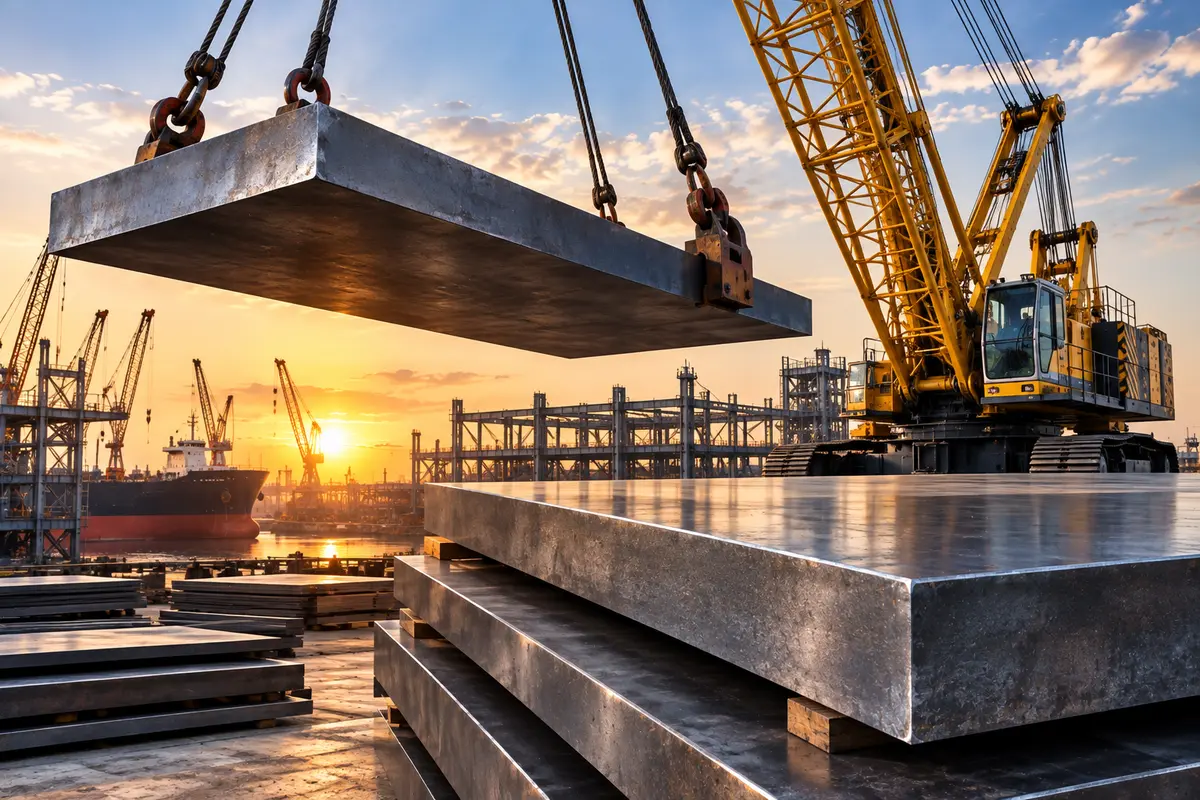
S690QL High Strength Steel: Complete Guide to Weight-Saving Structural Plates
S690QL is a quenched and tempered structural steel grade produced under EN 10025-6, prized for a minimum yield strength of 690 MPa — nearly triple that of standard mild steel. This guide explains what S690QL is, how it performs, and why it has become the default specification for weight-critical steel structures across cranes, transport, and lifting equipment.
Understanding the S690QL Designation
Each part of the designation carries specific meaning: 'S' stands for structural steel, '690' denotes the minimum yield strength in MPa, 'Q' indicates the quenched and tempered delivery condition, and 'L' signifies low-temperature impact testing at -40°C. This combination gives fabricators a grade with both exceptional strength and proven toughness in cold operating environments.
Mechanical Properties
Per EN 10025-6, S690QL delivers a minimum yield strength of 690 MPa and tensile strength of 770–940 MPa for sections up to 50mm, with elongation of at least 14%. Impact toughness is guaranteed at three temperature points — 50 J at 0°C, 40 J at -20°C, and 30 J at -40°C — giving engineers confidence in both static strength and dynamic performance in sub-zero conditions.
Why S690QL Enables Lighter Structures
Because S690QL carries roughly 2.75 times the yield strength of IS 2062 E250 mild steel, engineers can specify significantly thinner plate sections for identical load-bearing requirements — often achieving 20–30% weight reduction. In heavy transport manufacturing, this translates into 15–20% higher payload efficiency and reduced lifetime fuel consumption, while mobile cranes and lifting equipment gain greater reach and capacity for the same chassis weight.
Welding S690QL: Key Considerations
S690QL requires more disciplined welding practice than mild steel. Preheating is generally recommended above 20–30mm combined thickness to avoid hydrogen-induced cold cracking in the heat-affected zone. The t8/5 cooling time — the rate at which the weld cools between 800°C and 500°C — must be carefully controlled: too fast and the HAZ becomes brittle, too slow and strength is lost. Low-hydrogen consumables and controlled heat input are essential. Hot forming above 580°C is not permitted, as it destroys the quenched-and-tempered properties; only cold forming is suitable.
Applications & Sourcing in India
S690QL is specified for mobile cranes, heavy transport trailers, mining roof supports, lifting equipment, and offshore structures where every kilogram of dead weight matters. Convergence Steel supplies S690QL plates from 8mm to 100mm thickness, sourced from established European, Japanese, and Korean mills, with full EN 10204 3.1/3.2 certification and material traceability.
Conclusion
S690QL offers one of the best strength-to-weight ratios available in commercially stocked structural steel, making it the natural choice for cranes, lifting equipment, and heavy transport where payload efficiency drives project economics. Contact Convergence Steel for stock availability and welding guidance for your fabrication.
Get a Free Consultation