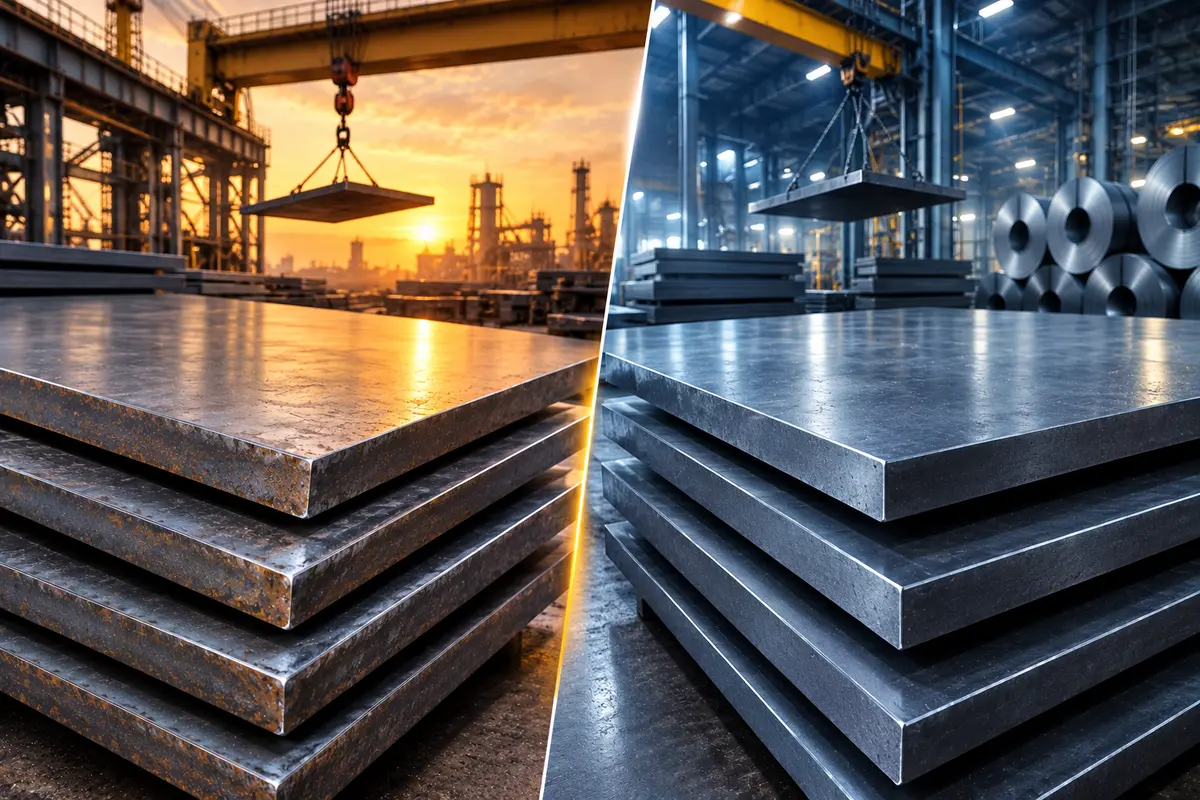
IS 2062 E350 High Tensile Steel: Why Infrastructure Projects Choose It Over E250
As infrastructure projects grow larger and dead-load reduction becomes a bigger design priority, many structural engineers are upgrading from standard IS 2062 E250 to the higher-strength E350 grade. This article explains what sets E350 apart and when the upgrade makes engineering and economic sense.
What is IS 2062 E350?
IS 2062 E350, also referenced as Fe 490, is a high-tensile hot-rolled structural steel plate with a guaranteed minimum yield strength of 350 MPa — 40% higher than standard E250. It retains good weldability through a controlled carbon equivalent (max 0.42%), making it accessible to standard fabrication shops without extensive preheating for common thicknesses.
Strength-to-Weight Advantage
The higher yield strength of E350 allows structural engineers to specify thinner plate sections while carrying identical loads to a thicker E250 section. In large infrastructure projects — high-rise buildings, heavy bridges, and offshore platforms — this reduced dead load can produce significant material savings, smaller foundations, and easier logistics for oversized structural members.
Chemical Composition & Mechanical Properties
E350 caps carbon at 0.20%, manganese at 1.55%, with phosphorus and sulphur held below 0.045%. Mechanically, it guarantees a minimum yield strength of 350 MPa, tensile strength of 490 MPa minimum, and elongation of 22%. For colder climates or dynamic loading conditions, E350C is available with impact testing at -20°C or 0°C.
Weldability Compared to E250
E350 is slightly more demanding to weld than E250 due to its higher strength and carbon equivalent, but it is still classified as having good weldability. Low-hydrogen electrodes are recommended, though extensive preheating is not typically required for standard structural thicknesses — making the transition from E250 straightforward for most fabrication shops.
When to Choose E350 Over E250
Choose E350 when dead-load reduction is a design priority, when the structure must withstand higher dynamic loads, or when project economics favour fewer, thinner plates over more numerous thicker E250 sections. E350 is internationally equivalent to EN 10025 S355JR/J0/J2, making it a familiar specification for projects with international engineering input.
Conclusion
For infrastructure and heavy structural projects where weight and load capacity are both critical, IS 2062 E350 offers a compelling upgrade path from standard E250 without sacrificing fabricability. Convergence Steel stocks E350 in thicknesses from 4mm to 150mm with full mill certification.
Get a Free Consultation